
🇮🇳 Tamil / Heritage of Tamils (Value Education Subject – First Year Engineering)
“Heritage of Tamils” (Tamil / Value Education course) is a common first-year engineering subject designed to help students understand the rich cultural, historical, linguistic, and ethical heritage of Tamil civilization. It also promotes value-based education, ethics, and social responsibility.
This subject is especially included in universities like Anna University as part of the foundational curriculum.
📘 Overview
This course focuses on:
-
Tamil language and its classical heritage
-
Ancient Tamil culture and civilization
-
Ethics, moral values, and human development
-
Social responsibility and cultural identity
-
Contributions of Tamil literature, art, and science
It is not just about language—it is about understanding identity, history, and values.
🏺 Unit 1: Ancient Tamil Civilization
Key Topics:
-
Indus Valley and Sangam-age connections
-
Early Tamil kingdoms (Chera, Chola, Pandya)
-
Trade and maritime history of Tamils
-
Ancient Tamil society and lifestyle
Importance:
Helps understand the deep historical roots of Tamil culture and global trade links.
📜 Unit 2: Sangam Literature & Tamil Language
Key Topics:
-
Sangam literature (Ettuthogai, Pattupattu)
-
Grammar works like Tolkappiyam
-
Evolution of Tamil language
-
Classical Tamil poetry and themes
Importance:
Shows Tamil as a classical language with rich literary tradition.
🏛️ Unit 3: Arts, Architecture & Culture
Key Topics:
-
Temple architecture (Chola temples, Dravidian style)
-
Tamil music, dance, and performing arts
-
Sculptures and inscriptions
-
Festivals and cultural traditions
Importance:
Highlights Tamil Nadu’s artistic and architectural excellence.
⚖️ Unit 4: Ethics and Human Values
Key Topics:
-
Moral values in Tamil literature (Aathichudi, Thirukkural)
-
Ethics in personal and professional life
-
Social responsibility and civic sense
-
Human rights and equality
Importance:
Builds character, discipline, and ethical thinking in engineering students.
🌍 Unit 5: Modern Tamil Society & Development
Key Topics:
-
Role of Tamils in modern science and technology
-
Industrial and educational development in Tamil Nadu
-
Tamil diaspora across the world
-
Digital Tamil and modern media
Importance:
Connects tradition with modern development and innovation.
🎯 Skills You Gain
-
Cultural awareness and identity understanding
-
Ethical and moral decision-making
-
Respect for heritage and diversity
-
Communication and value-based thinking
📌 Importance in Engineering
Even though it is a non-technical subject, it is important because:
-
Builds ethical engineers and responsible citizens
-
Encourages cultural pride and awareness
-
Supports soft skills and communication
-
Helps in personal and professional development
🌟 Key Takeaway
The Heritage of Tamils / Value Education subject ensures that engineering students are not only technically skilled but also morally grounded, culturally aware, and socially responsible professionals.
- Teacher: Admin User
📐 Engineering Graphics / Engineering Drawing (First Year Engineering)
Engineering Graphics (or Engineering Drawing) is a fundamental subject in the first year of engineering that teaches students how to represent 3D objects on 2D planes using standardized drawing techniques. It is often considered the language of engineers.
This subject is essential for branches like Mechanical, Civil, Automobile, Aerospace, and Production Engineering.
📘 Overview
Engineering Graphics helps students:
-
Understand shapes, dimensions, and object visualization
-
Develop spatial (3D) thinking ability
-
Learn technical drawing standards used in industries
-
Communicate engineering designs clearly without ambiguity
It mainly uses tools like drawing boards, AutoCAD (in some colleges), compass, scale, and pencils.
📏 Unit 1: Introduction to Engineering Drawing
Key Topics:
-
Importance of engineering drawing
-
Drawing instruments and their usage
-
Standards (BIS / ISO conventions)
-
Lettering and dimensioning rules
-
Scales (reduced, full, enlarged)
Goal:
Learn basic drawing techniques and technical standards.
📐 Unit 2: Geometrical Construction
Key Topics:
-
Construction of lines, angles, triangles, polygons
-
Division of line segments
-
Bisecting angles and lines
-
Construction of regular shapes
Applications:
-
Foundation for mechanical and architectural drawings
📊 Unit 3: Orthographic Projection
Key Topics:
-
Concept of projection
-
First angle projection system
-
Top view, front view, side view
-
Conversion of 3D objects into 2D views
Applications:
-
Machine part drawings
-
Civil structure design
📐 Unit 4: Isometric Projections
Key Topics:
-
Isometric scale
-
Conversion of orthographic views to isometric view
-
Drawing 3D objects in a simplified format
Applications:
-
Product design visualization
-
Engineering model representation
🔄 Unit 5: Sectional Views & Development of Surfaces
Key Topics:
-
Cutting planes and sectional views
-
Types of sections (full, half, offset)
-
Development of surfaces (cylinders, cones, prisms)
-
Unfolding of 3D shapes
Applications:
-
Manufacturing and fabrication
-
Sheet metal design
🎯 Skills You Gain
-
Strong spatial visualization ability
-
Technical drawing accuracy
-
Understanding of engineering design communication
-
Preparation for CAD software (AutoCAD, SolidWorks)
📌 Importance in Engineering
Engineering Graphics is important because:
-
It is the foundation of design and manufacturing
-
Helps in reading and creating engineering blueprints
-
Essential for mechanical design and architecture
-
Bridges manual drawing skills with CAD tools
🖥️ Modern Relevance
Today, Engineering Drawing is often connected with:
-
AutoCAD
-
SolidWorks
-
CATIA
-
3D modeling software
-
🖥️ AutoCAD basics for beginners
- Teacher: Admin User
💻 Problem Solving & Python Programming (First Year Engineering)
Problem Solving & Python Programming is an introductory computer science subject taught in the first year of engineering. It focuses on developing logical thinking, algorithmic problem-solving skills, and basic programming using Python.
This subject is common in universities like Anna University and other Indian technical universities.
📘 Overview
This course helps students:
-
Learn how to solve problems step-by-step (algorithmic thinking)
-
Understand programming fundamentals using Python
-
Write simple programs for real-world problems
-
Build a foundation for advanced programming subjects like Data Structures, AI, and Web Development
Python is used because it is:
-
Easy to learn
-
Readable and simple syntax
-
Widely used in industry and AI/ML
🧠 Unit 1: Problem Solving Techniques
Key Topics:
-
Problem definition and analysis
-
Algorithm development
-
Flowcharts and pseudocode
-
Step-by-step logical thinking
-
Basic computational thinking
Goal:
Learn how to convert a problem into a structured solution before coding.
🐍 Unit 2: Introduction to Python Programming
Key Topics:
-
Python basics (syntax, indentation)
-
Variables and data types
-
Input and output functions
-
Operators (arithmetic, logical, relational)
-
Control statements (if, if-else, nested if)
Example:
Simple programs like:
-
Even or odd number
-
Largest of three numbers
-
Basic calculator
🔁 Unit 3: Control Structures & Loops
Key Topics:
-
forloop -
whileloop -
Nested loops
-
Loop control statements (
break,continue,pass)
Applications:
-
Pattern printing
-
Sum of series
-
Prime number checking
-
Factorial computation
📦 Unit 4: Functions and Data Structures
Key Topics:
-
Functions (built-in and user-defined)
-
Parameters and return values
-
Recursion (basic level)
-
Data structures:
-
Lists
-
Tuples
-
Sets
-
Dictionaries
-
Applications:
-
Modular programming
-
Student marks processing
-
Data storage and retrieval
📁 Unit 5: Files, Strings & Basic Applications
Key Topics:
-
String manipulation
-
File handling (read/write)
-
Exception handling (basic)
-
Simple real-world Python applications
Applications:
-
File-based student records
-
Text processing
-
Simple data analysis programs
🎯 Skills You Gain
-
Logical thinking and algorithm design
-
Python programming fundamentals
-
Debugging and problem analysis
-
Building small applications
📌 Importance in Engineering
This subject is important because it:
-
Forms the base for all programming subjects
-
Prepares students for coding interviews and internships
-
Helps in AI, Data Science, IoT, and software development careers
-
Builds strong computational thinking skills
- Teacher: Admin User
📘 Engineering Chemistry (First Year Engineering)
Engineering Chemistry is a fundamental first-year subject in B.E./B.Tech that explains how chemistry is applied in engineering systems, materials, and industrial processes.
Engineering Chemistry
🎯 Objective of Engineering Chemistry
-
Understand basic chemical principles used in engineering
-
Study materials used in industries and technology
-
Learn about water treatment, fuels, corrosion, and polymers
-
Develop knowledge for real-world engineering applications
📚 Major Units in Engineering Chemistry (Anna University Pattern)
💧 1. Water Technology
-
Hard water & soft water
-
Boiler problems (scale, sludge)
-
Water treatment methods (ion exchange, reverse osmosis)
-
Desalination
👉 Used in power plants, industries, boilers
🔥 2. Fuels & Combustion
-
Types of fuels (solid, liquid, gaseous)
-
Calorific value
-
Octane & cetane number
-
Combustion process
👉 Used in engines, automobiles, energy systems
🧪 3. Engineering Materials
-
Polymers (plastics, rubber)
-
Composites
-
Nano materials basics
-
Properties of materials
👉 Used in construction, electronics, aerospace
⚙️ 4. Corrosion Science
-
Rusting of iron
-
Types of corrosion
-
Prevention methods (galvanizing, painting, cathodic protection)
👉 Important for bridges, machines, pipelines
⚡ 5. Electrochemistry
-
Batteries (dry cell, lithium-ion)
-
Electrolysis
-
Fuel cells
👉 Used in electric vehicles, electronics, energy storage
🌿 6. Environmental Chemistry
-
Pollution (air, water, soil)
-
Green chemistry concepts
-
Waste management
👉 Important for sustainability and environmental protection
🧪 Chemistry Lab Experiments
Common practicals include:
-
pH measurement
-
Hardness of water analysis
-
Conductivity experiments
-
Estimation of acids and bases
-
Corrosion rate study
🧠 Why Engineering Chemistry is Important
✔ Helps in understanding industrial processes
✔ Important for material selection in engineering design
✔ Useful in environmental protection and sustainability
✔ Supports fields like mechanical, civil, chemical, ECE
📌 Simple Understanding
Engineering Chemistry = “Chemistry used in real engineering applications”
It connects:
👉 Chemistry → Materials → Industry → Technology
📍 Quick Summary
-
Focus on water, fuels, materials, corrosion, batteries
-
Strong lab component
-
Useful in all engineering branches
-
🎯 Easy revision cheat sheet for exams
- Teacher: Admin User
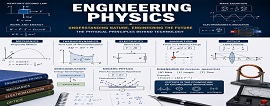
📘 Engineering Physics (First Year Engineering)
Engineering Physics is a fundamental first-year subject in B.E./B.Tech that connects basic physics concepts with engineering applications. It helps students understand how physics is used in modern technology and devices.
Engineering Physics
🎯 Objective of Engineering Physics
-
Build strong foundation in scientific principles
-
Understand how technology works physically
-
Develop analytical and problem-solving skills
-
Support advanced engineering subjects (like electronics, mechanics, materials)
📚 Major Units in Engineering Physics (Anna University Pattern)
⚛️ 1. Properties of Matter
-
Elasticity (stress, strain, Young’s modulus)
-
Viscosity and fluid flow
-
Surface tension
👉 Used in civil engineering, mechanical design, hydraulics
🌊 2. Wave Optics
-
Interference & diffraction
-
LASER principles
-
Applications of optical instruments
👉 Used in fiber optics, communication systems, medical devices
⚡ 3. Quantum Physics
-
Wave–particle duality
-
Schrödinger equation basics
-
Quantum theory applications
👉 Used in semiconductors, microelectronics
🔋 4. Electricity and Magnetism
-
Electric field & potential
-
Magnetic field concepts
-
Electromagnetic induction
👉 Used in motors, generators, transformers
💡 5. Modern Physics
-
Atomic structure
-
Nuclear physics basics
-
Radioactivity
👉 Used in nuclear energy, medical imaging
🧪 6. Semiconductor Physics
-
P-type & N-type materials
-
Diodes and transistors
-
Electronic devices basics
👉 Used in all electronic gadgets (mobile, computer chips)
🧠 Why Engineering Physics is Important
✔ Builds base for Electronics, ECE, EEE, CSE hardware concepts
✔ Helps understand how devices work internally
✔ Important for competitive exams and higher studies
✔ Improves scientific thinking and logic
🧪 Laboratory (Physics Lab)
Common experiments include:
-
Torsional pendulum
-
Young’s modulus measurement
-
Laser experiments
-
Semiconductor characteristics
📌 Simple Summary
Engineering Physics = “Physics applied in real engineering systems”
It connects science → technology → engineering applications
- Teacher: Admin User
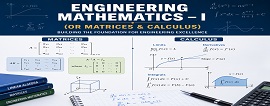
Engineering Mathematics – I (Matrices & Calculus) is one of the core foundational subjects in the first semester/first year engineering curriculum (commonly in Anna University and many Indian universities). It builds the mathematical base required for all engineering branches such as CSE, ECE, EEE, Mechanical, Civil, etc.
📘 Overview
Engineering Mathematics – I focuses on two major areas:
-
Matrices (Linear Algebra basics)
-
Differential & Integral Calculus
These topics help students develop analytical thinking and problem-solving skills used in engineering applications, simulations, and technical computations.
📊 Unit 1: Matrices (Linear Algebra)
This unit introduces matrix concepts used in engineering systems.
Key Topics:
-
Types of matrices (square, diagonal, symmetric, etc.)
-
Matrix operations (addition, multiplication, transpose)
-
Determinants and inverse of matrices
-
Rank of a matrix
-
Solving systems of linear equations (Gaussian elimination, Cramer’s rule)
-
Eigenvalues and eigenvectors (basic introduction in some syllabi)
Applications:
-
Circuit analysis in EEE
-
Structural analysis in Civil Engineering
-
Computer graphics transformations
-
Data modeling and AI systems
📈 Unit 2: Differential Calculus
Deals with rates of change and slopes of functions.
Key Topics:
-
Limits and continuity
-
Differentiation techniques
-
Chain rule, product rule, quotient rule
-
Partial differentiation (in some syllabi)
-
Maxima and minima (optimization problems)
-
Curvature and radius of curvature (basic level)
Applications:
-
Velocity and acceleration in physics
-
Optimization in engineering design
-
Machine learning gradients (basic idea)
📉 Unit 3: Integral Calculus
Focuses on accumulation and area under curves.
Key Topics:
-
Indefinite integrals
-
Definite integrals
-
Integration techniques (substitution, parts, partial fractions)
-
Application of integrals (area, volume)
-
Mean value theorems (in some syllabi)
Applications:
-
Finding area and volume in engineering design
-
Signal processing
-
Probability and statistics foundation
🎯 Skills You Gain
-
Logical reasoning and analytical thinking
-
Mathematical modeling of engineering problems
-
Problem-solving accuracy
-
Preparation for advanced subjects like Engineering Mathematics II, Signals, and Algorithms
📌 Importance in Engineering
Engineering Mathematics – I is not just a subject—it is the foundation of all technical learning. Most engineering problems are translated into mathematical models using matrices and calculus.
-
📊 Simple formula sheet for exams
- Teacher: Admin User
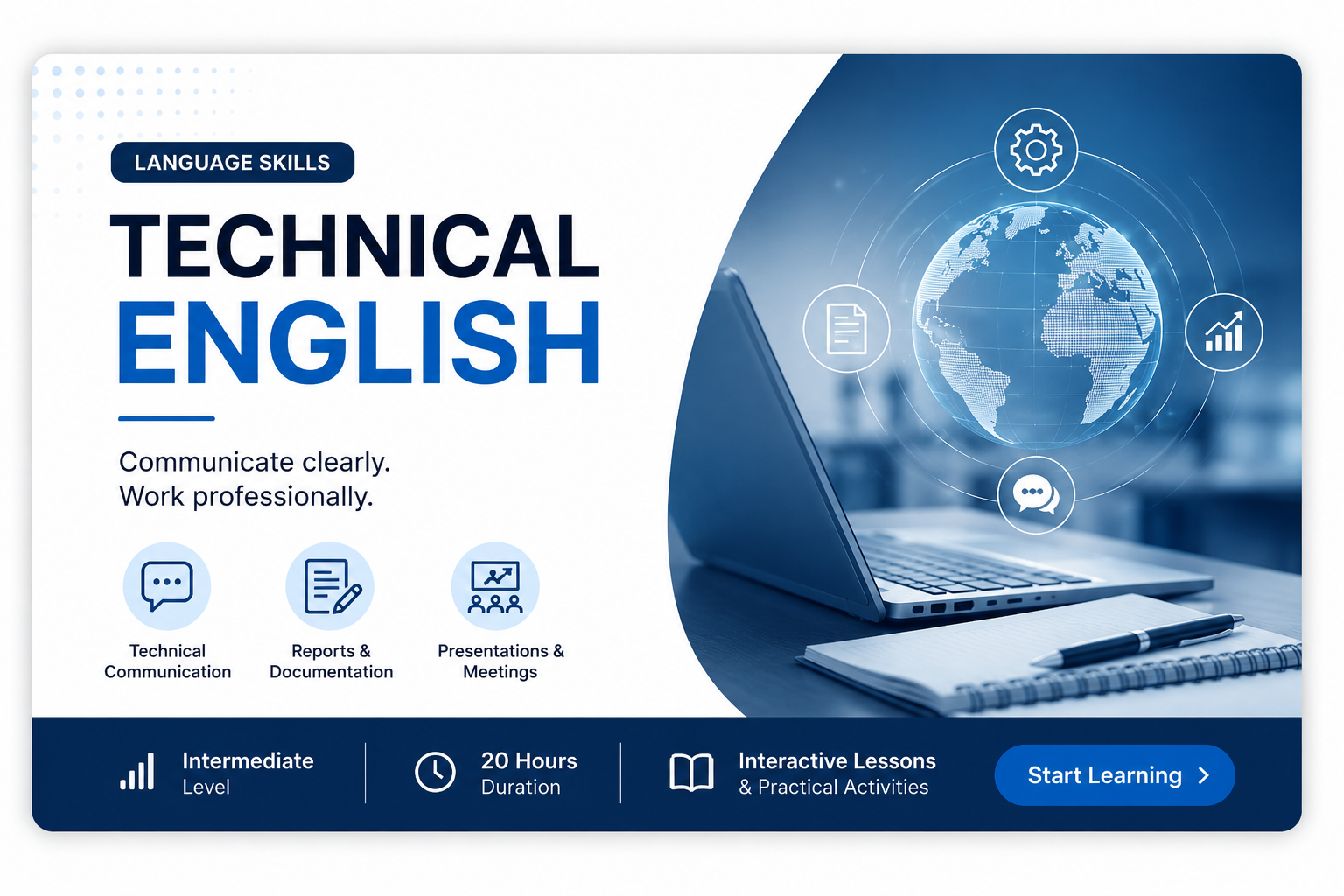
Technical English – Engineering First Year | First Semester
This course is designed for first-year engineering students to improve professional communication and technical language skills. The subject focuses on developing listening, speaking, reading, and writing abilities required in academic and workplace environments.
Course Highlights
-
Technical Communication Skills
-
Grammar and Vocabulary Development
-
Professional Email & Report Writing
-
Presentation and Public Speaking Skills
-
Reading Technical Documents
-
Group Discussion & Interview Preparation
-
Workplace Communication Basics
Suitable For
-
B.E / B.Tech First Year Students
-
Engineering First Semester Learners
-
Polytechnic & Diploma Students
Learning Outcomes
-
Communicate confidently in technical environments
-
Write clear engineering reports and documentation
-
Improve presentation and teamwork communication
-
Develop industry-ready English proficiency
Course Type
-
Engineering Foundation Subject
-
First Year – First Semester
-
Technical English / Professional English
LMS Card Short Description
“Build strong communication and professional English skills for engineering studies and future careers.”
- Teacher: Admin User